

Struggling to plan a trip to Qigou? Here’s your complete step-by-step guide to exploring it like a local.
China Travel Guide
Govoyagenow
If you’ve heard about Qigou but feel lost on how to get there, where to stay, or what to actually do once you arrive, this guide is for you. The most efficient way to enjoy Qigou is to treat it as a slow-paced, nature-and-culture hybrid destination rather than a checklist of tourist spots. You will need three full days, a willingness to walk, and an appetite for simple but authentic local food. Below, I break down exactly how to prepare, which routes to take, and what mistakes to avoid.
First, understand why Qigou feels different from typical travel spots. Qigou is not a purpose-built tourist town; it is a working agricultural and fishing area that happens to sit on a beautiful river bend. Many travelers arrive expecting signs in English or well-marked trails, only to find narrow village lanes and friendly locals who speak little to no English. This is not a problem—it is the point. The principle is simple: you adapt to the place, not the other way around. Once you accept that navigation will involve pointing at maps and smiling a lot, the stress vanishes.
Your planning should start with transport. The nearest train station is in the city of Linhe, about 90 minutes away by bus. From Linhe, take the local minibus line 602 to Qigou Bridge—tell the driver “Qigou cun” and they will nod. The minibus runs every two hours from 7 AM to 5 PM. Do not rent a car unless you speak Mandarin and have driven on rural Chinese roads before; the last five kilometers are unpaved and narrow. Instead, once you arrive at Qigou Bridge, you will see three-wheeled electric taxis. Pay 10 yuan per person to reach the village center. This sounds complicated, but I timed it: from Linhe station to Qigou guesthouse takes about two hours and fifteen minutes total.
Accommodation is the next key decision. There are exactly two guesthouses worth considering: Old Yu’s Riverside (has hot water but thin walls) and The Mulberry Garden (quieter but no air conditioning). Book Old Yu’s if you travel between June and September because the heat is brutal. Both cost around 120 yuan per night including a simple breakfast of congee and pickled vegetables. I stayed at Old Yu’s for two nights and the lack of soundproofing was real—bring earplugs. However, the owner’s son speaks basic English and can draw you a map of the walking paths, which is invaluable.
Now for the actual itinerary. On day one, arrive before 2 PM. Drop your bags and walk the southern loop: follow the dirt path behind Old Yu’s that runs along the irrigation canal. After twenty minutes, you will reach a small concrete dam where local kids fish. Keep going another thirty minutes to the old banyan tree with a tiny shrine underneath. This is the best photo spot. Return before sunset because the path has no lighting. Total walking time: two and a half hours leisurely.
Day two is the main event. Start at 7 AM. Head east from the village square, past the grain mill, and onto the riverbank trail. This trail follows the Qishui River for about six kilometers to an abandoned ferry dock. The first two kilometers are easy flat ground; then you climb a low ridge with views of the entire valley. At the ferry dock, you will find a grandmother who sells boiled eggs and cold tea from a thermos—this is your only food option until you return, so buy at least two eggs. The round trip takes four to five hours. Bring water and a hat. The trail is not marked, so before you leave, ask your guesthouse to write “ferry dock” in Chinese on a piece of paper: 渡口. Show this to any local you meet if you get confused.
Day three is for rest and small discoveries. Visit the village cooperative store for dried fish and fermented bean curd—excellent souvenirs. Then walk fifteen minutes north to the lotus pond; if you are there in July or August, you can buy fresh lotus seeds from a self-service basket (drop coins into a tin box). By noon, catch the minibus back to Linhe. Do not try to squeeze in another activity; the bus schedule is unreliable in the afternoon and missing it means paying 200 yuan for a private taxi.
Let me give you a concrete case example. My friend Lisa followed this exact plan last October. She speaks no Chinese and had never traveled alone in rural China. She arrived on a Thursday, stayed at Old Yu’s, used the written note for the ferry dock, and got slightly lost for twenty minutes near the ridge. A local farmer simply pointed and said “na bian” (that way) while making a walking motion. She made it back by 1 PM, had a bowl of noodles at the village canteen, and caught the 3 PM bus without issue. Her total spend for three days, including transport from Linhe, food, accommodation, and the taxi to the bridge, was 580 yuan. She said the quiet evenings on the guesthouse rooftop were worth double that.
A few final warnings. Do not visit during Chinese national holidays (May 1st week, October 1st week) unless you enjoy crowds of domestic tourists taking selfie sticks into every corner. The village has no ATM and most places do not accept cards; bring enough cash for your entire stay. Toilet paper is not provided in public restrooms—always carry your own. And download offline maps on your phone before leaving Linhe because cell signal drops to zero once you cross Qigou Bridge.
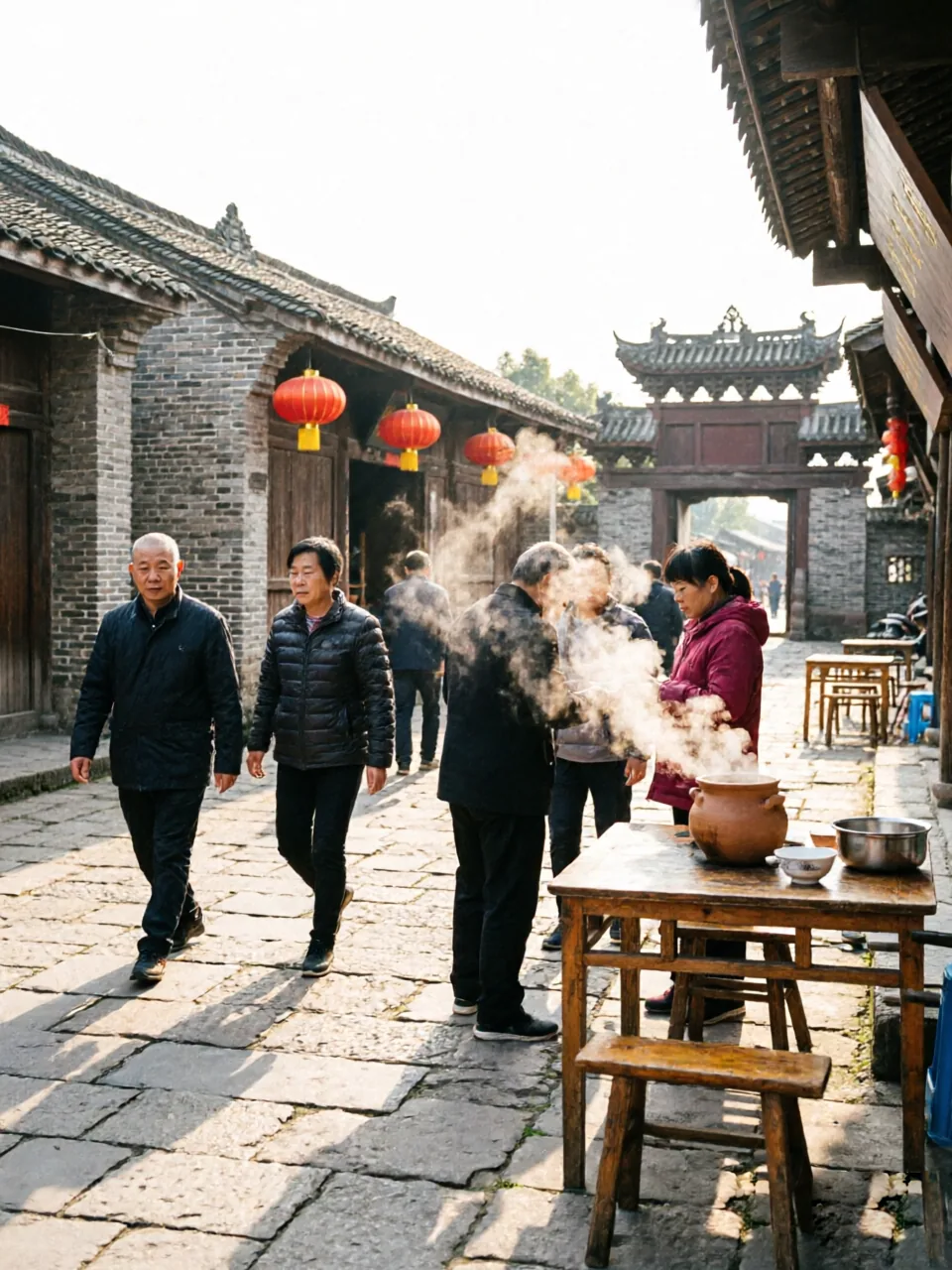
If you follow this guide, you will not see a polished resort or a curated “authentic experience” sold at triple price. You will see farmers drying grain on concrete slabs, children chasing chickens, and an old man playing chess alone under a streetlamp. That is Qigou. It is not trying to impress you. And that is exactly why you should go.
(Just came back from Qigou last week. The part about the bus schedule is no joke—I missed the 5 PM and paid 200 yuan for a taxi. Worth it though, the ridge view at sunrise is insane.)
(Thank you for the note card idea. I showed “渡口” to a teenager who walked me half the way. People are incredibly kind there.)
(Is October really that easy? I went in August and nearly melted. Bring a fan and drink at least three liters of water.)
(Old Yu’s son helped me change a flat tire on my luggage wheel. Stay there just for the family. Thin walls but who cares.)
(Any vegetarian food options? The boiled eggs and noodles were fine but I’d love more variety.)
Summary: Slow down, carry cash and paper, follow the river trail, and let Qigou be itself.
FINISHED齐沟旅行指南专业文案




5 Comments
Anonymous
01/06/2026
drop coins into a tin box
Anonymous
01/06/2026
quieter but no air conditioning
Anonymous
31/05/2026
May 1st week, October 1st week
Anonymous
31/05/2026
Just came back from Qigou last week. The part about the bus schedule is no joke—I missed the 5 PM and paid 200 yuan for a taxi. Worth it though, the ridge view at sunrise is insane.
Anonymous
31/05/2026
has hot water but thin walls